Spin Cycle, Sonnet Cycle: Why Experimental Writers Belong in the Laundrette
There is a particular smell to publicly funded literature: fresh coffee, new carpet and the faint anxiety of a gallery invigilator wondering whether you are going to touch the art. I say this with affection. Libraries and galleries do good work. But in 2026, with arts budgets squeezed and every funding application promising ‘engagement’, we need to admit that the UK has a residency problem: too many writers are being parked in the same nice rooms.
The residency-industrial complex has a waiting list for the nice rooms
Libraries, galleries, museums, heritage sites: all lovely. All staffed by people who already know what a writer is. The audience arrives expecting literature, which is nice for the writer and useless for the form. Experimental writing does not need more people who are already on the mailing list. It needs the woman with a bin bag of bedding, the bloke eating chips out of paper, the teenager waiting for a bus that is not coming. Not as ‘hard-to-reach communities’. As people with better things to do.
This is not an argument against libraries. It is an argument against the idea that culture happens only where there is a laminated floor and a risk assessment. A launderette is a public building. A chip shop is a public building. A bus station is a public building with better plot twists than most novels.
What the launderette knows about narrative
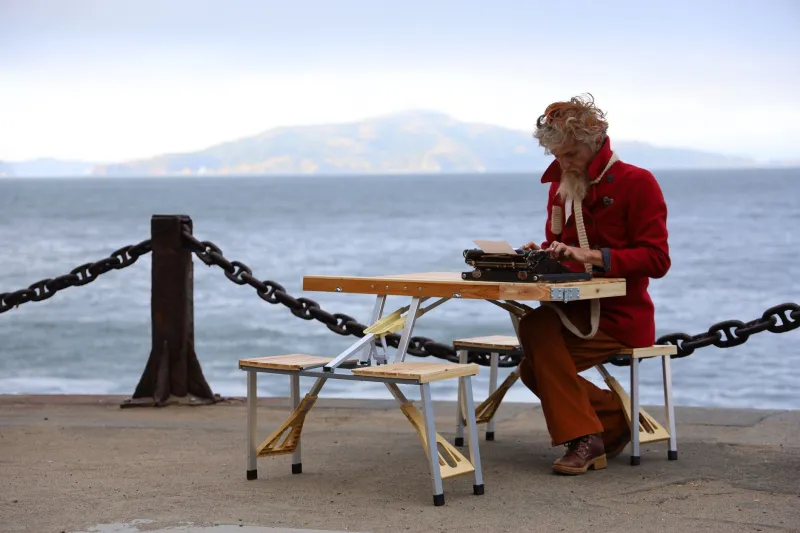
Laundrettes are plot machines. There is the cycle: wash, rinse, spin, repeat. There is the waiting. There is the lost sock, the stranger’s conversation, the child asleep on a pile of coats, the handwritten sign about not overloading the drum. A writer paid to sit there for a fortnight notices things. They do not have to interview anyone. They can write a pamphlet called Spin Cycle. They can print poems on receipts. They can leave a sonnet sequence on the noticeboard and see whether anyone moves it.
Chip shops have queues, which are villanelles with salt on. Bus stations have departure boards, which are erasure poetry waiting to happen. Bowling alleys have scorecards, league nights and the peculiar diplomacy of shared shoes. None of this is automatically good art. But it is material, and it is not the material that gets workshopped to death in a seminar room with a nice view of a canal.
The point is not to turn ordinary Britain into content. The point is to let experimental writing happen in earshot of people who have not opted into a literary festival. A poem on a chip-shop receipt is not a conversion strategy. It is a small, strange interruption. That is what experimental writing is for.
A modest proposal: the Odds and Ends Residency
Pilot it in 2026. Six writers, six places, one year. A launderette in Tottenham, a chip shop in Barry, a bus station in Bradford, a bowling alley in Hull, a market stall in Cardiff, a community centre in Glasgow. Each writer is paid at least a proper fee. Each venue is paid for heat, light and staff time. Each project gets a small budget for a pamphlet, a public poem and one free event that does not require a booking fee or a lanyard.
Fund it through Arts Council England project grants, local authority culture pots and the National Lottery doing what it says on the tin. Do not measure success by footfall. Measure unexpected encounters. Did anyone read a poem who did not mean to? Did the writer learn something that ruined their next novel? Did the venue want to do it again?
This is not about parachuting a novelist into a deprived area to write a poem called ‘Community’. It is about paying writers to notice the country they actually live in, and paying the places that host them. Consent, dignity and fair pay are not bureaucratic extras; they are the whole point. No photographs of anyone’s smalls. No turning service users into characters. No ‘engagement’ that means a writer talks at people who are trapped by the spin cycle.
The objections, and why they smell faintly of damp
Objection one: this is gimmicky. It can be. So can every residency with a nice chair. The difference is that the launderette does not pretend to be neutral. It is warm, noisy and full of other people’s pants. Experimental writers have spent a century trying to get out of the seminar room. Let’s meet them halfway, by the tumble dryers.
Objection two: writers will be exploited for ‘community engagement’. Only if we let them. Pay the writer, pay the venue, get consent, and do not make the local audience do the emotional labour of justifying the grant. A residency should be a transaction, not an extraction.
Objection three: the public does not want experimental writing. Correct. Most people do not want anything until it is in front of them and free and not asking for a subscription. But we are not trying to convert the nation to concrete poetry. We are trying to make the spaces where people already wait a little stranger, a little more alive to language. Britain is not short of places where people wait. It is short of writers paid to notice. Put us in the launderette. We will bring a notebook and exact change.