Gravy Is an Unreliable Narrator: Six Ways to Plot Your Novel Like a Carvery
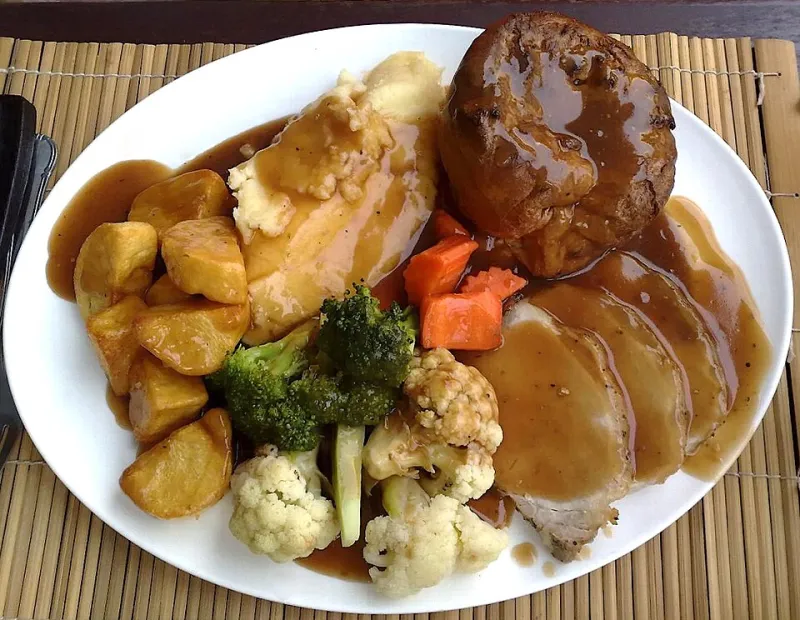
Photo: Jeff McNeill, CC BY-SA 2.0, via Wikimedia Commons
Every writer is told the same thing: three acts, inciting incident, midpoint, climax, resolution. It is the literary equivalent of a carvery that has been serving the same lukewarm carrots since 1994. Reliable, yes. Exciting, no. The British Sunday roast, on the other hand, is a messy, regional, emotionally loaded narrative system. It has expectation, delay, gravy, disappointment, gravy again, and a nap that arrives like a denouement you did not know you needed. If you want your novel to misbehave, stop treating plot as a pyramid and start treating it as a plate.
Yorkshire pudding is a prologue
It arrives before the main event. It makes promises. If it is crisp and towering, the reader settles in: this is a meal that knows what it is doing. If it is soggy, the reader starts to worry about the narrator. The Yorkshire pudding is not a side dish. It is a contract. It says: here is the tone, here is the appetite, here is the slightly reckless confidence with which I intend to proceed. A good prologue should do the same. It should not explain the whole plot. It should make the reader hungry for the plot, and slightly suspicious of the gravy.
Gravy is an unreliable narrator
Gravy coats everything. It claims to bind the meal together. It tells you that the dry bits are actually delicious, that the veg is not sad, that the meat is not overdone. Sometimes it is telling the truth. Sometimes it is cornflour and stock and a bit of panic. Every novel has a gravy problem: the thing the narrator says holds the story together may be exactly the thing hiding the cracks. Is the voice smooth because it is wise, or smooth because it is evasive? Is the plot thick because it is rich, or because someone added too much flour? Let the gravy lie a little. Let the reader notice the lumps.
The meat is the plot, the veg is the subplot
You cannot build a roast out of gravy. You need something to carve. The meat is your central narrative: the thing everyone has come for, the thing that takes up space on the plate. The veg is everything else: the subplots, the minor characters, the thematic parsnips. A good roast gives the veg its own butter and its own reason to exist. A bad novel treats subplot as decoration. A good one lets the red cabbage have a secret. If your subplot is just boiled carrots because the plate looked empty, put down the pen and pick up the tongs.
Six roast-inspired plot models
1. The Carvery Queue
A braided narrative. Several characters shuffle forward in the same line, each with a different appetite, each revealing a different version of the same event. The queue is not an obstacle; it is the structure. Every time the line moves, the point of view shifts. By the time they reach the counter, the reader knows that the woman in front is not just choosing between beef and turkey; she is deciding whether to forgive her brother. Use this for ensemble novels, family sagas, and anything set in a municipal building with a laminated sign about tongs.
2. The Meat Sweats Spiral
A rising-action spiral where every chapter adds another meat, another stakes, another terrible decision. It starts with a modest slice of chicken and ends with three kinds of sausage and a existential crisis. This is the plot model for thrillers, farces, and any novel where the protagonist keeps saying ‘just one more thing’ until the reader wants to lie down. The spiral is not the same as escalation. Escalation is louder. The spiral is richer, heavier, and increasingly likely to end with someone taking their jumper off.
3. The Veggie Option
A parallel narrative that refuses to be an afterthought. The vegetarian roast is not a lesser roast; it is a different roast with its own logic, its own gravy, and its own crisis about whether the nut roast is actually nice or just polite. Run two storylines side by side. Do not make one the ‘real’ plot and the other the consolation prize. Give the veggie option its own climax. Give it a Yorkshire pudding, for heaven’s sake. Readers can tell when a narrative has been microwaved separately.
4. The Cauliflower Cheese Deus Ex Machina
A late arrival that changes everything. The cauliflower cheese appears after the plate is already full, and suddenly the meal makes sense. In fiction, this is the plot development that arrives from the side, seemingly out of nowhere, and rescues the story. Use it sparingly. A good cauliflower cheese is earned by the promise of the menu; a bad one is a random side dish thrown at a struggling third act. If your ending depends on a character you introduced on page 247 arriving with a cheese sauce and a secret will, the reader may throw a roast potato at you.
5. The Endless Refill
A loop narrative. The carvery keeps offering more. The protagonist keeps returning to the counter, each time with a slightly different plate and a slightly worse understanding of their own appetite. This is the experimental model: repetition with variation, escalation through sameness, the horror and comfort of a bottomless roast. It can be comic, it can be eerie, it can be both. Use it when you want to ask what a character really wants, and then ask again, and then ask again with more gravy.
6. The Nap
The denouement is not an epilogue. It is the nap. After the climax, the reader needs to digest. The nap is not laziness; it is narrative processing. It is the bit where the body says: enough, let the meal settle. Give your ending room to breathe. Do not jolt the reader awake with a final twist that belongs in a different restaurant. Let the plates be cleared. Let someone say something quietly devastating about the washing-up. Then let the reader drift, pleasantly unable to move.
Stop carving the same pyramid
The three-act structure is not wrong. It is just overdone, like a carvery that has been under a heat lamp since noon. The roast offers other shapes: queues, spirals, parallel plates, late cheese, endless refills, and the sacred nap. Try one. See what happens when your plot stops trying to be a pyramid and starts trying to be a plate. It might be messy. It might be uneven. It might leave the reader with a strange desire to ring their mother. That is not a bug. That is dinner.