Page 888 Was My Writing Tutor: The Teletext Grid as a Brutal Little Editor
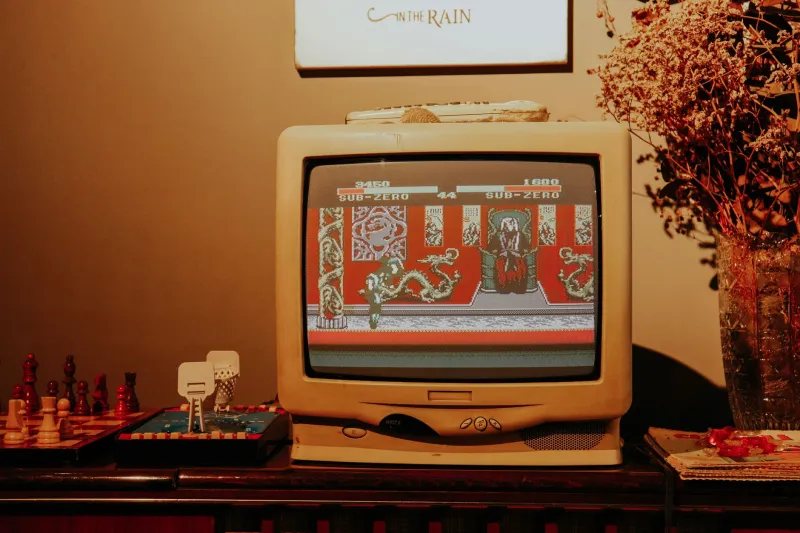
There is a particular kind of silence that falls over a room when someone says the word ‘Ceefax’. It is not the silence of reverence. It is the silence of people trying to remember whether they ever actually used it, or whether they are simply remembering a television that did. And yet, for anyone who writes, the teletext grid remains one of the most useful ghosts in the machine.
Ceefax launched on the BBC in the 1970s and staggered on until 2012, when the digital switchover finally pulled the plug. In between, it taught a country to read on a screen that had the emotional warmth of a filing cabinet and the spatial generosity of a matchbox. Forty characters across. Twenty-four lines down. No italics. No em dashes unless you were prepared to argue with the engineering. It was a form so tight that adjectives had to queue outside.
This is not nostalgia. Nostalgia is for people who want to go back. Literary archaeology is for people who want to dig the thing up, steal its teeth and wear them as a necklace. The teletext grid is not a relic. It is a constraint engine, and it is sitting there, unplugged, waiting for experimental writers to realise what they have been missing.
The tyranny of forty characters
Most writing advice tells you to cut ten per cent. The teletext grid tells you to cut everything that is not load-bearing. You cannot write ‘the rain fell relentlessly on the miserable town’ when you have forty characters and a line break coming. You write ‘RAIN. TOWN. NO JOY.’ You write it in block capitals because that was the default and because lower-case teletext was for show-offs and subtitles.
What emerges is not simply brevity. It is a particular kind of rhythm — the rhythm of a form that has been punched into shape by a machine. Sentences become staircases. Repetition becomes a design feature. The rolling headline at the bottom of the screen, the one that cycled through the same three stories every eight seconds, teaches you more about refrain than most poetry workshops. It is the original infinite loop, and it was broadcast into living rooms before anyone thought to call it experimental.
And there were subpages. Oh, the subpages. A single page number could hide a dozen separate screens, each one appearing in sequence, each one refusing to be pinned down. You wanted the football results? You got page 302, subpage 1 of 6, and by the time subpage 4 arrived you had forgotten what you were looking for. This is not a bug. This is an unreliable narrator with a scheduling problem.
A short history of accidental literature
Teletext was never designed to be art. It was designed to deliver news, weather, flight times and the football results to people who did not want to wait for the six o’clock bulletin. But because it was cheap and because it was strange, it attracted strange people. Oracle, the commercial rival, ran competitions and puzzles. Channel 4’s Digitiser turned video game reviews into a daily pantomime of talking bins and surreal running jokes. Bamboozle, the quiz, made a generation feel clever and slightly seasick at the same time. Page 888 gave us subtitles for people who could not hear, and in doing so gave us a masterclass in compression: dialogue stripped to the bone, context carried by timing and the flicker of a block graphic.
The teletext art scene never quite died. Festivals have kept the form twitching. Artists still make pages that will never be broadcast, pixel-perfect homages to a screen that most people under thirty have never seen. But the literary potential has been quietly ignored. We have spent decades fetishising the typewriter and the Moleskine while a far more brutal editing tool sat in the corner of the living room, beeping softly, waiting to be asked.
How to write for a dead screen
Here are some prompts. They are not exercises. They are instructions for a heist.
Use page numbers as chapter titles. Not ‘Chapter One’. Page 101. Page 302. Page 888. The numbers carry their own associations — 101 is basic, 302 is sport, 888 is subtitles, the place where speech becomes text. Let the number do work that a title would otherwise have to do badly.
Make subpages your unreliable narrators. Write a story in six screens, each one claiming to be the ‘real’ version. Screen 1 of 6 is confident. Screen 4 of 6 contradicts it. Screen 6 of 6 is just a weather map and a single line of apology. The reader has to assemble the truth from the sequence, and the sequence is never quite the same twice.
Steal the rolling headline. Take one sentence — preferably a boring one, like ‘COUNCIL APPROVES NEW BIN SCHEDULE’ — and repeat it after every paragraph. Watch how repetition turns bureaucracy into incantation. Watch how the meaning changes when the surrounding text gets stranger.
Write in blocks. Teletext graphics were made of sixel blocks, chunky and crude. Translate that to prose: no flowing paragraphs, just hard little units of text separated by white space. It is the opposite of the lyric essay. It is the lyric spreadsheet.
Kill your adverbs. You have forty characters. An adverb is a luxury you cannot afford. ‘She walked quickly’ becomes ‘SHE RAN’. ‘He said angrily’ becomes ‘HE SNAPPED’. The grid does not care about your feelings. The grid cares about the line break.
The Irregular Writers Teletext Anthology
We are proposing something mischievous. We want you to write a page. Not a story that happens to be short — a page. Twenty-four lines. Forty characters. A page number. A subpage count if you are feeling cruel. Send it to us via the submissions page and we will assemble the best into a digital anthology, a ghost broadcast for a screen that no longer exists.
It does not need to be about teletext. It does not need to be nostalgic. It needs to be constrained. The grid is the point. The grid is the editor that never sleeps and never tells you your work is ‘brave’. The grid just tells you it does not fit, and waits for you to try again.
Page 888 was my writing tutor. It never praised me. It never explained itself. It just flashed the same three words at the bottom of the screen until I understood: cut, cut, cut. Somewhere in that flicker, a literature was waiting. Let us go and dig it up.