Murder in the K6: A Village Phone Box and the Case of the Missing Middlebrow
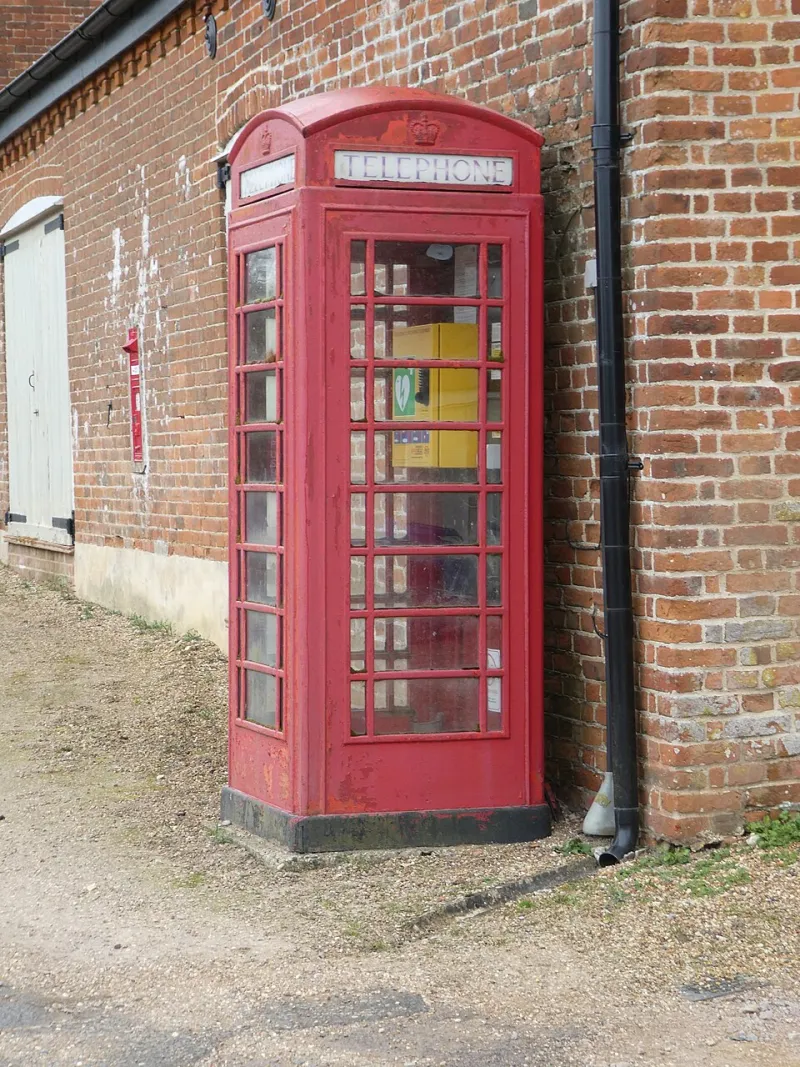
Photo: Sebastiandoe5, CC BY-SA 4.0, via Wikimedia Commons
On the village green in a parish whose name I have promised not to reveal — because the culprit may be reading this — stands a red K6 telephone box. It has no dial tone. It has a shelf, a laminated notice saying Please Take a Book, Leave a Book, and the unmistakable atmosphere of a scene that has been disturbed. Someone has been here. Someone has taken the good stuff. And someone, bless them, has left a copy of Cold Comfort Farm with a bookmark made from a Tesco receipt and a note reading: ‘This is funnier than it looks. Keep going.’
This is not a library. It is a crime scene with a door that sticks.
The Body in the Box
Let us be clear about the genre. This is not a cosy mystery; it is a golden-age puzzle with damp. The red kiosk was designed by Sir Giles Gilbert Scott in 1935, and for decades it was a piece of public infrastructure with a very clear purpose: you went in, you said something urgent, you came out. Now, in 2026, many of them have been adopted by parishes, painted, planted with marigolds and turned into book exchanges. The result is a tiny, unsupervised literary institution with no catalogue, no fines and no alibi.
The absence of a corpse should not distract us. A missing copy of a Richard Osman novel is a body-shaped hole in the shelf. A vanished Sylvia Plath is a psychological disappearance. A Haynes manual for a Ford Cortina that has been taken and not returned is, frankly, a motive.
A Library With No Catalogue and No Alibi
Phone-box libraries are the closest thing Britain has to public space that has not been monetised, monitored or asked to accept cookies. They are maintained by someone’s neighbour, usually a retired teacher called Marion, who restocks them with charity-shop duplicates and a quiet sense of civic menace. No one stamps the books. No one checks the returns. There is no security camera, unless you count the suspicion of the woman walking her labradoodle.
That is precisely why they are interesting. A phone box library is a narrative engine built on constraint: perhaps sixty books, one shelf, British weather, and a public that treats ‘leave a book’ as a loose suggestion. It is Oulipo by accident. It is an exquisite corpse with a door handle.
Every Gap Is a Plot Hole
When you read a phone-box shelf, you are not reading a collection. You are reading an edited anthology whose editor has absconded. The gaps are the best bits. Who took the only Lee Child? Was it a commuter, a teenager, a man named Keith with a caravan? Why are there three copies of The Da Vinci Code and no copy of Middlemarch? Is that a clue, or just Britain?
In experimental fiction, we talk about ellipsis, the unsaid, the productive absence. The phone box does this without theory. Every missing title is a prompt. Every space on the shelf asks the reader to reconstruct a borrower. The shelf becomes a detective story in which the detective is also a suspect, because you, too, have taken something and left something worse.
The Anonymous Notes Are the Chorus
Then there are the notes. Pencilled inside covers, written on Post-its, sometimes scrawled on the back of a petrol receipt: ‘Did anyone actually finish this?’ ‘Yes, and I’m still annoyed.’ ‘If you took the Atwood, bring it back or I will write a sequel.’ These are marginalia as Greek chorus. They turn solitary reading into a conversation with strangers who may be lovely, may be lunatics, and are definitely not being supervised by the parish council.
A phone-box library is therefore a collaborative novel written in installments by people who do not know they are collaborating. The notes are the footnotes. The missing books are the plot twists. The baffling donations are the red herrings.
Donations Are Red Herrings
No phone-box library is complete without a donation that makes no sense. A paperback Ulysses with a chip-shop receipt as a bookmark. A Mills & Boon inscribed ‘For Derek, sorry about the shed’. A guide to beekeeping in a village with no hives. These arrivals are not clutter; they are character evidence. They suggest lives, feuds, holidays, misplaced optimism. They are the equivalent of finding a single glove at the scene and deciding it belongs to the victim’s estranged brother.
A Laboratory for Collaborative Fiction
Here is the argument: experimental writers should stop hiring rooms for workshops and go straight to the nearest phone box. The constraints are delicious. You have a tiny cast of books. You have an unreliable narrator in the form of the laminated sign. You have a public that will interfere. You have weather. You have the possibility that someone will donate a Dan Brown and thereby ruin the mood.
A phone-box library is not nostalgic. It is a live laboratory for collaborative fiction, mutual aid and low-level literary mischief. It asks what happens when you leave a story alone with the public and no invigilator. The answer is: it becomes stranger, funnier and more honest than anything you could plot alone.
How to Read a Phone Box Like a Detective
- Treat the shelf as a cast list. Who is present? Who is conspicuously absent?
- Note the gaps. A missing thriller suggests appetite; a missing poetry pamphlet suggests a convert.
- Read the notes. They are the chorus, the clues and the strongest evidence that literature is a social act.
- Inspect the donations. The baffling ones are always the most revealing.
- Leave something odd. A book with a note is a plot device; a book without one is just furniture.
So next time you pass a red phone box with a shelf of paperbacks, do not think of nostalgia. Think of evidence. Think of the missing middlebrow, the anonymous note, the rogue bookmark. The butler did not do it. The butler took the Lee Child and left a copy of Ulysses with a chip-shop receipt. Case open.