Tuppence for Your Thoughts: What the Seaside Arcade Knows About Suspense
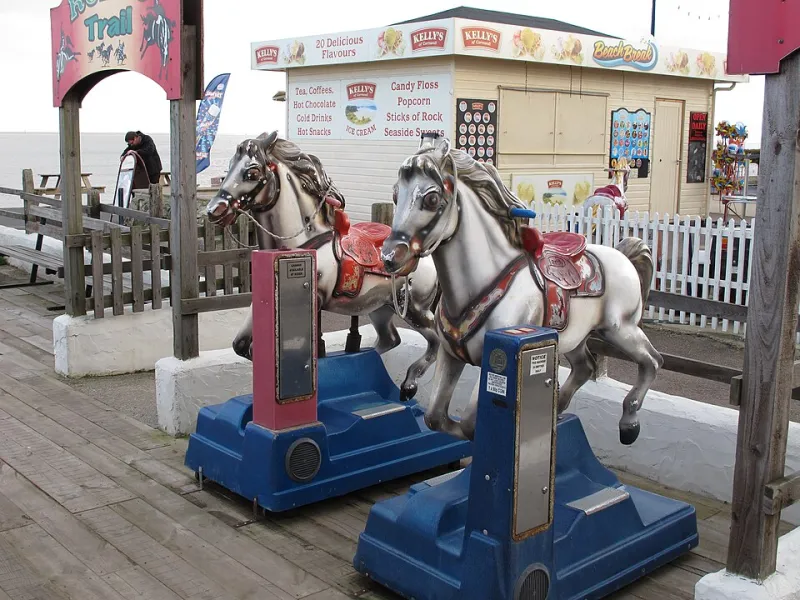
Photo: Roger Jones , CC BY-SA 2.0, via Wikimedia Commons
Blackpool smells of hot doughnuts and mild regret. The sea is over there, doing its usual grey shrug, but the real weather is inside the arcade: a warm fug of carpet cleaner, copper and concentrated hope. You put a 2p coin on the shelf. It teeters. It does nothing. A stranger’s coin drops six inches away and a whole cascade of other people’s money slithers into the tray. You have witnessed a plot twist, a betrayal and a lesson in narrative cruelty, all for two pence.
The British seaside arcade is not usually invited into creative writing seminars. It should be. The penny falls, the claw machine and the fortune-teller booth are accidental engines of suspense: mechanical little novelists that understand near-misses, false endings and the exquisite tedium of compulsion. They are also honest about what suspense is for. A story can make you lean in; so can a machine with a payout tray and a lighting rig. The difference is that one of them is trying to sell you a plastic frog.
The Shove Is the Inciting Incident
The 2p coin pusher is a slot machine that has been to a comprehensive school and learned to hide its teeth. Its plot is simple: you introduce a small object, it meets a moving shelf, and the shelf shoves it towards a precarious community of other small objects. Nothing happens. Then everything happens. Then nothing happens again, but with more coins.
This is the mechanics of suspense stripped of prose. The machine does not care about your protagonist’s childhood trauma. It cares about the gap between expectation and outcome. A good short story works the same way: it puts a character on the lip of change, lets them wobble, and then withholds the drop. The penny falls teaches us that a near-miss is not a failure of plot. It is the plot. The reader who says ‘just get on with it’ has never watched a ten-year-old will a 2p coin into a pile of silver with the intensity of a Method actor.
The Claw Machine Is an Unreliable Narrator
The claw machine is the arcade’s great liar. It promises agency. You line up the claw, you press the button, you watch the mechanism descend with the solemnity of a judge. The claw closes. It lifts. The prize — a plush octopus with one eye and a suspicious smell — rises, trembles, and is dropped. The machine has narrated your competence and then contradicted itself.
Experimental fiction loves an unreliable narrator, but the claw machine offers a useful reminder: unreliability is not just a matter of voice. It is a matter of physics. The story can say one thing and do another. The reader can see the gap. The best suspense comes from that gap, not from withholding information like a boring uncle guarding the last sausage roll. Let the reader see the claw. Let them believe in the claw. Then let the claw be a claw.
The Fortune-Teller Booth and the False Ending
The fortune-teller booth is the arcade’s haunted study. You put in a coin, a light flickers over a painted hand, and a card emerges with a prediction so vague it could apply to anyone: ‘A journey is possible. Beware a dark-haired stranger. Your lucky colour is beige.’ It is a plot that has given up on specificity and gone into local government.
But the booth knows something about endings. It gives you a card, not a conclusion. The machine’s promise is that the future is available for £1, but the future it delivers is a small rectangle of card with a typo. That is the false ending in miniature: the moment a story seems to resolve, then reveals that resolution was another hook. A good experimental poem can do this in six lines. A bad novel does it for four hundred pages and calls it a twist.
A Manual for Mechanical Suspense
So what can writers actually steal from the arcade? First, the ritual. The coin, the slot, the push, the wait. Suspense is often procedural: the reader needs to know the rules before they can dread the outcome. Second, the near-miss. A coin that almost falls is more gripping than a coin that never moves. Third, the tatty prize. The arcade does not offer transcendence. It offers a keyring. Your story can offer a small, specific, slightly disappointing object and still make the reader feel the cost of wanting it.
Finally, the arcade understands complicity. You are not watching someone else lose money; you are feeding the machine. The best fiction makes the reader aware of their own participation. They lean forward. They want the coin to drop. They know they have been manipulated. They stay anyway. That is not a flaw in the reader. It is the engine.
Exercises for the Tuppenny Draft
-
Write a 200-word scene in which a character puts a coin into a machine and nothing happens. Then make something happen that is smaller and stranger than they expected. Do not use the word ‘disappointment’.
-
Build a story around a false ending. Let the protagonist get exactly what they wanted in paragraph three, then show the payout tray. What else came with it?
-
Describe a room using only the logic of a claw machine: reach, grip, lift, drop. No metaphors about claws. Only the mechanism.
-
Write a poem from the point of view of a 2p coin on the shelf. It is aware of the shove. It has opinions about the other coins. It is not brave.
-
Set a scene in a British arcade in February. Everyone is in a coat. The machine is winning. Find the sentence that makes the reader want to put in another coin, then refuse to give it to them.
Cashing Out
The arcade is not a temple of literature. It is a room full of noise and sticky carpet, and the prizes are mostly landfill with a barcode. But it is also a plot machine. It knows that suspense is not a matter of grand revelations; it is a matter of the next small shove. It knows that disappointment can be funny, that compulsion can be beautiful, and that a story, like a penny falls, is mostly a question of what you are willing to feed into it.
So next time you are in Skegness or Southend or Whitby, and the rain is coming in sideways, give the arcade its due. Put in 2p. Watch the shelf. Learn the timing. Then go home and write something that teeters.
Irregular Writers will be in the café next door, arguing about the ending.