Everything Must Be Tiny: Model Villages, Bossy Paths and the Fiction of What’s Left Out
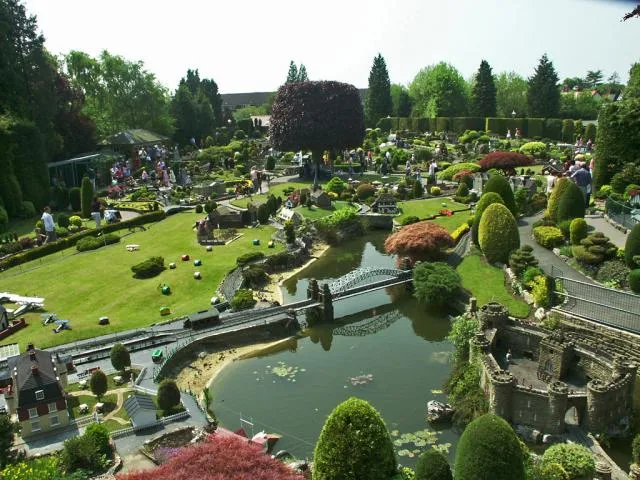
Photo: Peter Roberts, CC BY-SA 2.0, via Wikimedia Commons
The first thing you notice at a British model village is not the tiny houses. It is the way everyone lowers their voice, as if a normal-volume sentence might blow the roof off a miniature bakery. The second thing you notice is the path. It curls past the church, doubles back at the duck pond, nudges you towards the gift shop and absolutely refuses to let you cut across the bowling green. You are not exploring. You are being narrated.
This is not a complaint. It is a craft lesson. A model village is a first draft of Britain, and like most first drafts it is charming, selective and slightly sinister. Everything has been shrunk, but more importantly, everything has been chosen. The winding path is not a walkway. It is syntax. The missing bus shelter is not an accident. It is an edit.
The Path Is the Plot
A model village does not trust you to find your own way. It has opinions about where you should look, in what order, and for how long. The path leaves the ticket hut, swings you past the manor house, then tightens into a narrow lane so you cannot help but notice the tiny signal box. By the time you reach the bridge, you have been paced. You have been sequenced. You have been given a beginning, a middle and a mildly overpriced end.
Writers do this too, or should. A story is not a field. It is a route. The question is not only what happens, but what the reader is made to pass on the way. If every scene is equally visible from every angle, the reader wanders off. If the route is too rigid, the reader feels the handrail. The model village gets away with bossiness because it is delightful. Your novel probably cannot rely on a tiny duck pond to distract from the apparatus.
Still, steal the principle. Arrange scenes so that the next one is visible before the current one ends. Let a minor detail — a sign, a light, a smell — act as the bend in the path. The reader should feel they are discovering the story, even when they are being gently herded past the chip shop.
What Gets Shrunk, What Gets Erased
Here is where the model village becomes properly literary. At 1:12 scale, certain things survive: the parish church, the pub, the railway station, the bakery, the green. Certain things vanish: the vape shop, the bus shelter with the cracked timetable, the wheelie bins, the council flats, the kebab van, the betting shop, the puddle of unknown origin outside the pharmacy. The miniature is not a neutral copy. It is a heritage fantasy with secateurs.
That is worth noticing, because a lot of fiction does the same thing and pretends it has not. We shrink the world to a manageable set of symbols and call it realism. We leave out the litter and the admin and the people who cannot afford the manor house. The model village is at least honest about its omissions: it puts a tiny train in front of them and charges £9.50 for entry.
Experimental writers can use this. Ask what your story’s model village would include. If you were building your protagonist’s street at 1:12 scale, which three buildings would make the cut? Which would be quietly removed because they complicate the mood? The answer is not a moral judgement. It is a map of your narrative ideology. Every world has a gift shop, whether it admits it or not.
Scale Is an Unreliable Narrator
Miniature things look innocent. A tiny window box suggests a tiny person with tiny secateurs and tiny opinions about geraniums. But there is no person. There is only a suggestion of one, which is exactly what a good fictional detail does: it implies a world larger than the sentence that contains it.
This is where scale becomes unreliable. At 1:12, a privet hedge is charming. At full size, it is a boundary dispute. A model village can make poverty look picturesque by leaving it out. A novel can do the same by describing only the quaint end of the street. The lesson is not to cram everything in. It is to know what your scale is hiding. A precise detail is powerful because it stands in for a thousand others, but it is also a tiny act of propaganda.
So use detail like a model villager: sparingly, deliberately, and with the awareness that the reader will build a whole world from one wonky chimney pot. Just do not pretend the chimney pot is the whole of Britain.
Exercise One: Write a Scene at 1:12
Take a scene you are stuck on. Shrink it to 1:12. That means no weather, no backstory, no internal monologue longer than a sentence. Everything must be observed through a miniature scale: a gate, a hand, a cup, a light going on. The scene should still have a route. Decide what the reader passes first, second and last. Then write it in under 300 words.
The restriction is the point. At 1:12, you cannot fill space with atmosphere. You have to choose the objects that carry the story. If your scene still works when the only things visible are a kettle, a letter and a pair of muddy boots, you have found your load-bearing details. If it collapses, congratulations: you have discovered what you were actually writing about.
Exercise Two: Cut a Street to Three Objects
Pick a familiar British street — your high street, your nan’s road, the one by the station. List everything on it. Then cut it to the three objects that most tellingly reveal who lives there. Not the three prettiest. Not the three most nostalgic. The three that do the work.
Maybe it is a pharmacy sign with one letter broken, a bench with a plaque nobody reads, and a stack of wet cardboard outside the corner shop. Maybe it is a hanging basket, a security light and a child’s scooter. Write a paragraph that puts those three objects in a path. Do not explain them. Let the reader walk past.
The model village is a first draft because it has no arguments, no litter and no bus that fails to arrive. But it understands something experimental writers often forget: scale is not decoration. It is narrative control. The path knows where you are going. The tiny houses know what has been left out. The gift shop knows you will buy a pencil sharpener shaped like a cottage and call it a day.
Go anyway. Take notes. Then go home and shrink your story until it shows you what it is made of.