Mr Punch Has Your Three-Act Structure in a Headlock: Bootleg Plot Mechanics from the Seaside Booth
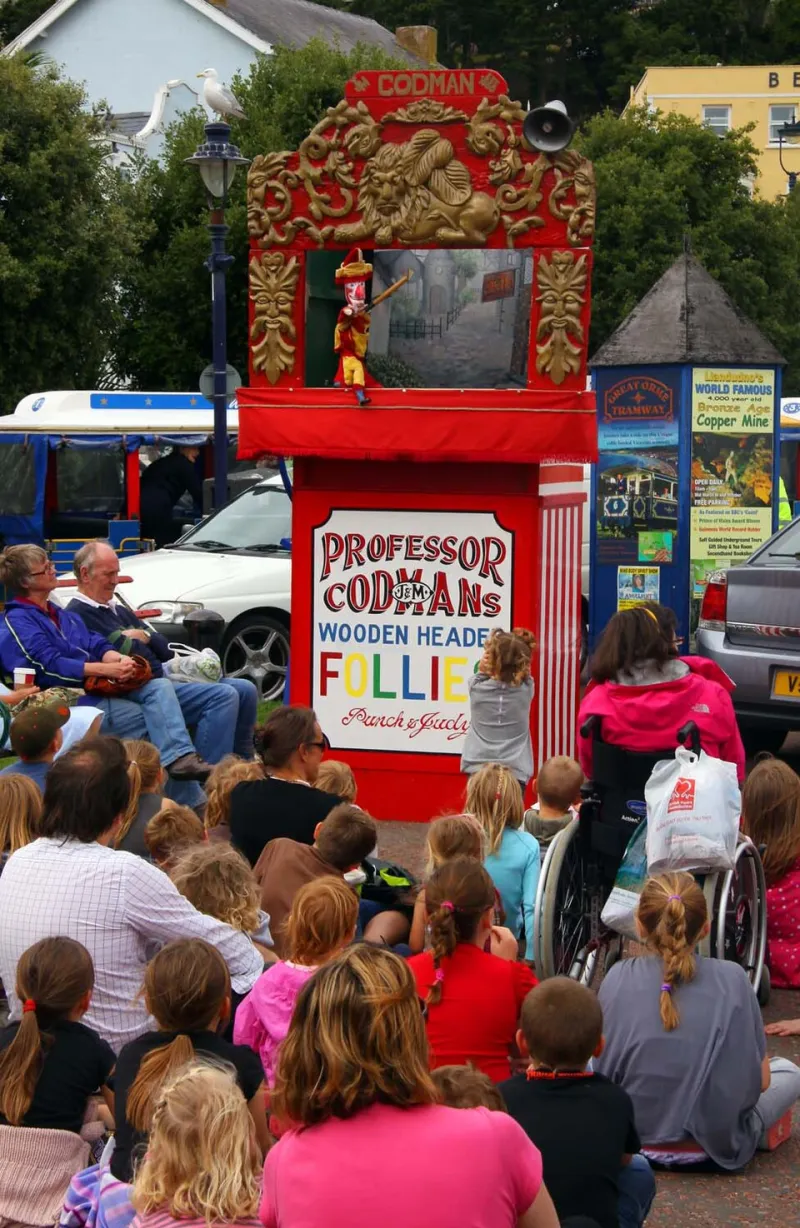
Photo: Steve Daniels , CC BY-SA 2.0, via Wikimedia Commons
There is a particular kind of British bank holiday weather that makes a puppet booth look like a reasonable career move: grey sky, aggressive chips, a seagull with the eye of a bailiff. And there, wedged between the arcade and a bin, is Mr Punch. He has been doing narrative structure since before your creative writing tutor was born. He has no MFA. He has a stick.
We tend to file Punch and Judy under ‘heritage nuisance’ — something to edge past on the way to a 99 Flake. But the booth is not a quaint relic. It is a bootleg plot engine: cheap, portable, ruthlessly efficient, and built to hold a crowd that has no obligation to stay. That is a far more honest model for experimental fiction than the three-act diagram in a how-to book. Nobody ever left a puppet show because the inciting incident was delayed. They leave because the puppets stop hitting each other.
A curriculum vitae written in slapstick
Punch and Judy is a centuries-old mongrel. Its ancestors include commedia dell’arte, European marionette traditions and the sort of English seaside improvisation that happens when it starts raining and the show must go on. Samuel Pepys recorded seeing a puppet show in 1662 — a genuine historical sighting, not a pub rumour. Since then, the show has been rewritten by every performer who ever needed to keep a crowd of sugar-crazed children from wandering into the sea.
That is the first lesson: the text is not sacred. The booth treats story as a live protocol. There are fixed turns, stock characters and a rough shape, but the actual performance is negotiated in real time with an audience that will heckle, lose interest or ask for the toilet. Experimental writers love to talk about ‘open texts’ and ‘readerly play’. Mr Punch has been running a participatory narrative environment for centuries, and he did it without a single artist’s statement.
The booth is a short-story machine
Think about the constraints. You have a tiny stage, a handful of puppets, a performer under a swazzle, and perhaps twenty minutes before the audience’s attention curdles. You cannot spend three pages on the weather. You cannot introduce a character called Peregrine who represents the decline of the Anglican Church. You have to make something happen, then make it happen again, harder.
That is not a limitation; it is a discipline. The booth is the literary equivalent of a single-room play with a trapdoor. It reminds us that plot is not a sequence of events but a sequence of turns — moments where the audience’s expectation is rotated ninety degrees. Punch does not ‘develop’. He escalates. The baby cries, the crocodile arrives, the policeman interferes, the ghost looms, the devil turns up, and nobody has time to workshop their backstory.
Stock characters are not stereotypes; they are functions
Experimental fiction often sneers at stock characters, then quietly reinvents them as ‘archetypal figures’ and puts them in a novel about a lighthouse. But the Punch and Judy cast is useful precisely because it is blatant. Mr Punch is the transgressive engine. Judy is the domestic counterweight. The Baby is the inciting incident with a rattle. The Policeman is institutional resistance. The Crocodile is consequence with teeth. The Devil is the final boss.
If you are revising a short story and it feels baggy, ask which function is missing. Is there a Judy — someone who wants a normal life and keeps being dragged into the plot? Is there a Crocodile — a consequence that arrives with its own soundtrack? Is there a Policeman — a rule that the protagonist must break in public? You do not have to keep the names. You can call them ‘Karen from HR’ and ‘the sensory void’. The function is what matters.
The turn is a scene with a trapdoor
A ‘turn’ in puppet theatre is a short unit of business: a bit of stagecraft, a gag, a chase, a song. It has its own micro-structure — setup, mischief, response, exit line — and it ends with a hook. The audience is never allowed to settle. That is why the show can survive mediocre weather and a crowd that has already eaten its own body weight in fudge.
The lesson for fiction is not ‘make everything a gag’. It is ‘make every scene a turn’. A turn changes the pressure. It might be comic, violent, absurd or quietly devastating, but it must rotate the scene. If a chapter ends exactly where it began, only with more adjectives, it is not a turn. It is a diorama.
Call-and-response is your narrator’s handbrake
‘That’s the way to do it!’ is not just a catchphrase. It is a contract. The audience knows when to shout, when to boo, when to warn the puppets that the crocodile is behind them. The performer hands out cues and the crowd hands back noise. The result is a story that feels like a game rather than a lecture.
Experimental fiction can use the same trick without turning into pantomime. Give the reader a rhythm they can recognise. Repeat a phrase, a gesture, a structural joke. Let a paragraph begin with the same three words each time, then break the pattern at the exact moment you want the reader to feel the floor move. Call-and-response does not require a literal audience. It requires a narrator who knows they have one.
Violence is escalation, not garnish
Punch and Judy is gleefully violent. The stick is not subtle. But the violence is structural: it is how the show raises stakes when the audience starts shuffling. In fiction, the equivalent is not necessarily a body count. It is the willingness to let consequences land. If your protagonist makes a mess, someone has to arrive with a bin bag and a disappointed expression. The Crocodile must actually eat something.
That is why so much experimental fiction feels bloodless: it is frightened of consequence. It will stage a beautiful rupture — a broken sentence, a dissolved identity, a talking wardrobe — and then politely pretend nothing has changed. Mr Punch would be appalled. He would hit it with a stick.
A Punch-and-Judy plot map for your next draft
Here is a mock revision tool. Take your short story and map it onto the booth.
- The parade: Who or what announces that we are in a story? This is your booth front, your painted promise. Do not make it tasteful; make it clear.
- The first turn: The protagonist does something they cannot undo. The Baby cries. The rattle is thrown. The neighbour is insulted.
- The second turn: A stock function arrives. Policeman, Judy, Crocodile, Devil. Give them a job, not a personality quiz.
- The third turn: Escalation via prop. The stick, the string of sausages, the ghost sheet. What object makes the next bit inevitable?
- The audience check: Where does the reader get to shout? Where is the catchphrase, the repeated line, the structural wink?
- The impossible return: The moment when the story could end, but the booth refuses. The crocodile is still out there. The devil has not had his scene.
- The curtain line: The final image or joke that sends them away. It does not have to resolve everything. It has to release the crowd.
Use it badly and you will write a farce. Use it well and you will write something that moves like a game: fixed enough to be legible, loose enough to be alive. The booth is not a museum. It is a machine for making trouble in public. Experimental fiction could do with more of that — and fewer laminated story pyramids.